

Let’s be real—forecasting the economy is a bit like predicting SF weather: fun to try, often wrong, but you learn to always carry a jacket, just in case.
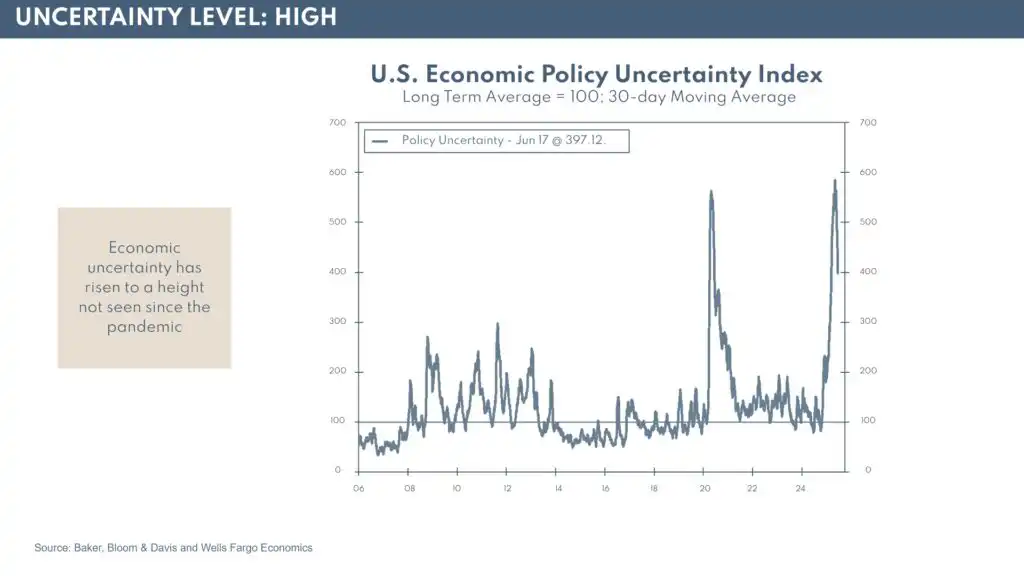
In all seriousness, we haven’t seen this degree of uncertainty since the Pandemic, which was already leaps and bounds above any other period in recent history. AKA – things are really hard to reliably predict. But, from everything we’re seeing, we are cautiously optimistic for the Fall, but much more optimistic for 2026. With that, here’s what’s moving the dial, what we’re watching, and why that optimism is particularly bright for the Bay Area.
BY THE NUMBERS
Tariffs on Deck
- New tariffs threaten to push costs higher—but they don’t hit the economy immediately. We’ll likely see a lag, which means inflation could stay sticky longer than expected.
- With tariffs, one of two things will happen – consumers will pay more, or companies will eat the cost, impacting their profit margins. If companies absorb the costs, they will need to look elsewhere to keep costs in check: wages and benefits, potentially resulting in layoffs.
- If layoffs accelerate, the Fed may pivot its current focus on inflation to focus more on unemployment, pushing rates lower in an effort to boost growth.
Labor Market: Teetering, Not Toppling
- Bay Area unemployment remains low: SF was ~3.6% in May vs. ~4.1% in Alameda County, and 3.4% in San Mateo County (vs California overall at 5.3%)
- However, we’ve seen hiring slow. California job openings dipped from 669K to 659K in March, reflecting slower hiring demand.
So far, layoffs are minimal – but the slowdown in hiring is a
red flag to watch
Fed & Mortgage Rate Expectations
- Markets expect three Fed cuts (25 bps each) between now and year-end, likely beginning in September.
- That said, remember that the FED doesn’t control mortgage rates. In fact, mortgage rates have already crept down, which shows they are already pricing in these expected cuts. So, further (mortgage) rate drops may be modest this year.
PSA: Reach out to talk about we’re helping our clients get rates in the 5s!
Of course, there is plenty to watch and be cautious about in the macro-economic environment. However, despite all of the national uncertainty, the Bay Area continues to show resilience—and even upside. Let’s dive into a few data points…
🌉 Bay Area Bright Spots: Why We’re Optimistic
SALT Cap Boost
- In the “One Big Beautiful Bill,” a SALT cap increase was passed from $10k (current) to $40K. This brings back some big tax benefits of home ownership and we expect it to disproportionately (positively) impact markets like ours where homes are more expensive and taxes are higher.

Office Leasing on the Upswing
- SF office leasing is still below pre-pandemic levels, but we’ve seen a recent jump, bigger than any other US market. Specifically, ~3M sq ft were leased in Q1—the highest since 2019. And, Q2 saw ~2.3M sq ft leased, pushing 2025 toward a post-COVID peak.
Leisure & Hospitality Rebound
- SF hotels had one of the strongest national rebounds in lodging performance through mid-year—good news for city vibrancy and investor interest.

Construction Still Creeping Along
- San Francisco added only ~1,600 housing units in 2024.
- With demand rising and supply constrained, homes and rents continue trending higher.

Rent Surge & Investor Interest
- We saw rents skyrocket as of late. Average SF rents now hover around $3,200/month—a dramatic bounce from pandemic lows. This could bring investors back into the market. In fact, in Q1, we saw $363M in multifamily deals, which was triple last year’s volume.

Tight Bay Area Inventory
- Bay Area supply remains quite a bit more lean (at ~2.8 months), compared to California at ~3.6 months and national averages at ~4.5 months. This metric (months of inventory) is one that we track to compare supply relative to demand, which clearly has a big impact on price.
- Seeing stats like this should be a good reminder to us all that we shouldn’t just take national headlines and assume the story is the exact same in the Bay Area.

SO WHAT?!
While macro trends may be unpredictable, there are a few Bay Area-specific tailwinds that give us optimism for the future.
Strategically, we’re cautiously eyeing the fall, looking for a possible seasonal uptick in activity. And peeking ahead? Many economists are predicting flat GDP this year, but a rise in growth for 2026. We believe this stronger growth will have positive impacts on our housing market momentum throughout 2026.

Have questions about your unique situation?! We’re here to help!